
{Prometheus and Man} {Pandora's Box} {Apple of Discord} {Achilles' Heel} {The Trojan Horse}
{Echo} {Golden Touch} {Sisyphus's Stone} {Labors of Hercules} {The Man Who Loves a Statue}
The
Trojan Horse 特洛伊木馬 (木馬屠城記)
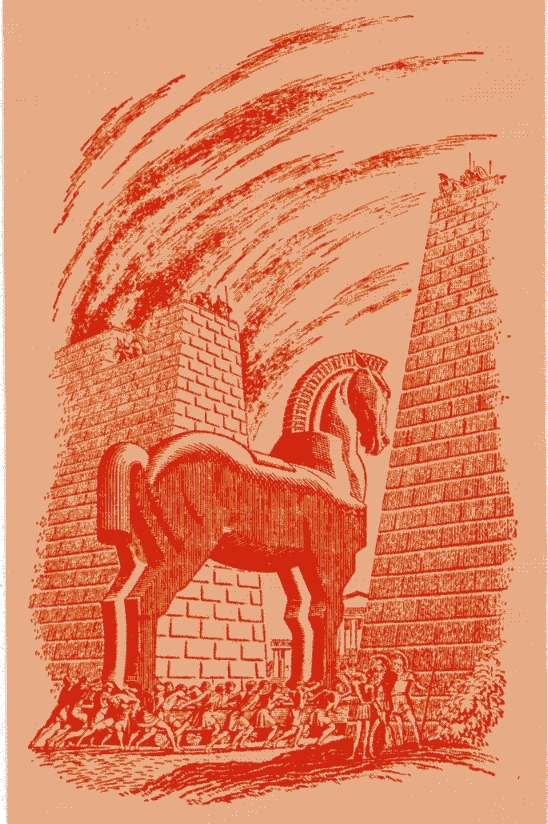 Troy still held out, and the Greeks began to despair of even subduing it by
force, and by advice of Ulysses resolved to resort to stratagem. They
pretended to be making preparations to abandon the siege, and a portion of the
ships were withdrawn and lay hid behind a neighboring island. The Greeks
then constructed an immense wooden horse, which they gave out was intended as a
propitiatory offering to Athena, but in fact was filled with armed men.
The remaining Greeks then betook themselves to their ships and sailed away, as
if for a final departure. The Trojans, seeing the encampment broken up and
the fleet gone, concluded the enemy to have abandoned the siege. The gates
were thrown open, and the whole population issued forth, rejoicing at the
long-prohibited liberty of passing freely over the scene of the late
encampment. The great horse was the chief object of curiosity. All
wondered what it could be for. Some recommended to take it into the city
as a trophy; others felt afraid of it.
Troy still held out, and the Greeks began to despair of even subduing it by
force, and by advice of Ulysses resolved to resort to stratagem. They
pretended to be making preparations to abandon the siege, and a portion of the
ships were withdrawn and lay hid behind a neighboring island. The Greeks
then constructed an immense wooden horse, which they gave out was intended as a
propitiatory offering to Athena, but in fact was filled with armed men.
The remaining Greeks then betook themselves to their ships and sailed away, as
if for a final departure. The Trojans, seeing the encampment broken up and
the fleet gone, concluded the enemy to have abandoned the siege. The gates
were thrown open, and the whole population issued forth, rejoicing at the
long-prohibited liberty of passing freely over the scene of the late
encampment. The great horse was the chief object of curiosity. All
wondered what it could be for. Some recommended to take it into the city
as a trophy; others felt afraid of it.
While they hesitate, Laocoon, the priest of Poseidon, exclaims, "What madness, citizens, is this! Have you not learned enough of Grecian fraud to be on your guard against it? For my part I fear the Greeks even when they offer gifts." Then perhaps the people might have taken his advice and destroyed the fatal horse and all its contents; but just at the moment a group of people appeared, dragging forward one who seemed a prisoner and a Greek. Stupefied with terror, he was brought before the chiefs, who reassured him, promising that his life should be spared on condition of his returning true answers to the questions asked him. He informed them that he was a Greek, Sinon by name, and that in consequence of the malice of Ulysses he had been left behind by his countrymen at their departure. With regard to the wooden horse, he told them that it was a propitiatory offering to Athena, and made so huge for the express purpose of preventing its being carried within the city; for Calchas the prophet had told them that if the Trojans took possession of it, they would assuredly triumph over the Greeks. This language turned the tide of the people's feelings, and they began to think how they might best secure the monstrous horse and the favorable auguries connected with it.
Suddenly a prodigy occurred which left no room to doubt. There appeared
advancing over the sea two immense serpents. They came upon the land, and
the crowd fled in all directions. The serpents advanced directly to the
spot where Laocoon stood with his two sons. They first attacked the
children, winding round their bodies and breathing their pestilential breath in
their faces. The father attempting to rescue them is next seized and
involved in the serpents' coils. He struggles to tear them away, but they
overpower all his efforts and strangle him and the children in their poisonous
folds. This event was regarded as a clear indication of the displeasure of
the gods at Laocoon's irreverent treatment of the wooden horse, which they no
longer hesitated to regard as a sacred object and prepared to introduce with due
solemnity into the city. This was done with songs and triumphal
acclamations and the day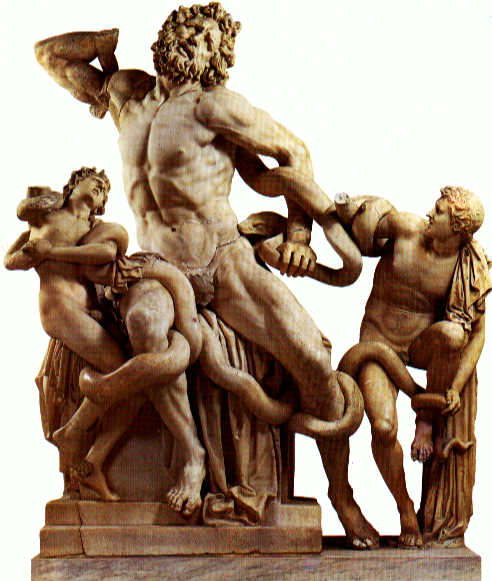 closed with festivity. In the night the armed men
who were enclosed in the body of the horse, being let out by the traitor Sinon,
opened the gated of the city to their friends who had returned under cover of
the night. The city was set on fire, the people, overcome with feasting
and sleep, put to the sword, and Troy completely subdued.
closed with festivity. In the night the armed men
who were enclosed in the body of the horse, being let out by the traitor Sinon,
opened the gated of the city to their friends who had returned under cover of
the night. The city was set on fire, the people, overcome with feasting
and sleep, put to the sword, and Troy completely subdued.
特洛伊城堅不可摧,希臘人開始對用武力攻破它失去信心,他們在尤里西斯的建議下,決定採用計謀。他們假裝準備放棄圍攻特洛伊城的打算,撤出一部分船隻,但偷偷地停泊在鄰近小島的後面。接著希臘人造了一艘巨大無比的木馬,散佈空氣說,他們將把木馬獻給雅典娜(Athena)以求贖罪,其實木馬裏面藏滿了武裝的士兵。留在特洛伊城外的希臘人紛紛登上船隻,揚帆出海,彷彿一去永不復返。特洛伊人看到軍營解散,戰船遠航,認為敵人放棄圍城計劃了。他們大開城門,全城百姓走出城外,為長期剝奪的自由,為能在以前軍營的地方自由地走動而歡欣鼓舞。巨馬是他們好奇觀察的主要目標。人人都對木馬的作用好奇不已。有的人建議把它拉進城去做戰利品;有的人看了心驚膽跳。
在他們猶疑不決時,波西頓的祭司勞孔(Laocoon)高聲說道:“公民們,你們犯甚麼糊塗!你們對希臘人的詭計知道得還不夠嗎?難道你們還不想提防它?”當時人們也許會聽從他的勸告,銷毀將致他們於死地的木馬及其腹中的一切。但是就在這個時刻來了一群人,拽了一個像是俘虜的希臘人。這個嚇得半死的人被帶到將領們跟前。他們安撫他,答應他,如果他對他們所提的問題老實回答,他們就饒了他的性命。希臘人俘虜告訴他們,他是希臘人,名叫西農(Sinon),由於尤里西斯的惡意,他的同胞們在撤離時把他留下了。至於那匹木馬,他告訴他們說,這是獻給雅典娜爭取和解的祭品,木馬造得這麼大,純粹是為了不讓人把它搬進城裏,因為先知卡爾卡斯(Calchas)告訴他們,如果特洛伊人獲得木馬,他們一定能戰勝希臘人。這番話語打動了人們的心,他們開始考慮怎樣才能牢牢獲得這匹巨馬和它帶來的吉兆。
就在特洛伊人猶豫不決的時候,突然發生了一件怪事,使人們不再三心兩意。原來海上出現兩條巨蛇慢慢地游了過來。它們來到陸地,人們四下逃散。巨蛇逕自來到勞孔和他兩個兒子站著的地方。它們首先襲擊兩個孩子,纏在他們身上,對著他們的面孔噴毒氣。勞孔企圖解救他們,但也被巨蛇纏繞。他拚命掙扎,想把它們扯開,但巨蛇們制服了他的一切努力,用它們有毒的身體纏住他和他的孩子們,把他們活活勒死。人們認為這件事清楚地表明神祇們不喜歡勞孔對木馬的不敬。他們不再遲疑,一致認為木馬是件聖物,打算以應有的敬意把它迎進城裏。他們載歌載舞,夾雜著勝利的歡呼把木馬拉進城裏,這一天以歡慶盛宴結束。半夜裏,載在木馬腹中的武裝士兵們由間諜西農放了出來,他們打開城門迎接在黑夜掩護下返回來的戰友們。他們放火燒了全城,把酒足飯飽正在酣睡的特洛伊人一一殺掉。特洛伊城終於全城陷落了。
註:Trojan horse 特洛伊木馬:比喻為內奸、潛伏內部的顛覆份子或集團,或者引起內部破壞的因素。